
Squat depth is one of the most debated topics in fitness. Some lifters say you should always squat deep, while others only go to parallel. The truth is that your ideal squat depth depends on your mobility, body mechanics, and training goals.
✅ What Is Squat Depth?
Squat depth refers to how low your hips travel during the squat. The three most common depth ranges are:
🔹 Quarter Squat
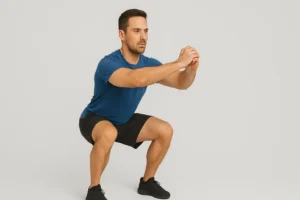
Very shallow bend; thighs stay well above parallel.
🔹 Parallel Squat
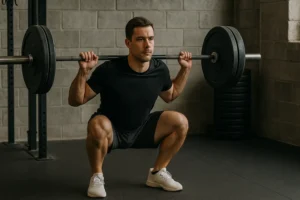
Thighs reach parallel — hip crease aligns with or slightly above the knee.
🔹 Deep Squat (ATG)
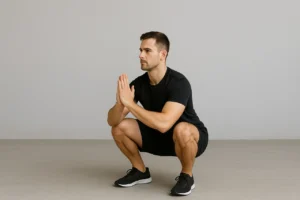
Hips go below the knees, creating a full-range squat.
Each depth activates your muscles differently, and each has its own benefits.
🔥 1. Quarter Squat
Depth: Roughly 25–45° knee bend; a shallow range of motion.
✔ Benefits
- Builds explosive power
- Useful for athletes (sprinters, jumpers)
- Allows heavier loads
❌ Drawbacks
- Minimal glute and hamstring activation
- Not ideal for full strength development
- Easy to overload with poor form
Best for:
Athlete-specific power training — not general fitness or strength building.
🔥 2. Parallel Squat (Standard Depth)
Depth: Thighs reach parallel to the floor — hip crease level with knees.
✔ Benefits
- Balanced quad + glute activation
- Ideal for muscle and strength development
- Standard depth for powerlifting
- Comfortable for most lifters
❌ Drawbacks
- Requires moderate hip and ankle mobility
- Less glute activation compared to deep squats
Best for:
Most lifters — beginners, intermediates, strength trainees, athletes.
🔥 3. Deep Squat (ATG — Ass-to-Grass)
Depth: Hips drop below knee level.
✔ Benefits
- Maximum glute activation
- Improves mobility and flexibility
- Builds strength through full range
- Essential for Olympic lifting
❌ Drawbacks
- Requires strong mobility
- Harder to maintain upright posture
- Not suitable for those with knee/hip pain
Best for:
Lifters with good mobility, Olympic lifters, mobility-focused training.
⭐ So… How Low SHOULD You Go?
Your ideal squat depth depends on three things:
✔ 1. Your mobility
Good ankle/hip mobility = deeper squats.
✔ 2. Your goals
Strength → parallel
Mobility or Olympic lifting → deep
Power → quarter squat
✔ 3. Your body structure
Some people naturally squat deeper due to hip anatomy.
👉 Rule to follow:
Go as low as you can while keeping perfect form: neutral spine, heels flat, knees aligned, and no pain.
🎯 How to Find YOUR Ideal Squat Depth
Use this 5-step decision guide:
🔸 1. Keep a neutral spine
Stop before your lower back rounds (butt wink).
🔸 2. Keep your heels flat
If heels lift → your depth is too low for your current mobility.
🔸 3. Watch knee alignment
Knees should track over toes — not collapse inward.
🔸 4. Maintain balance
You shouldn’t fall forward or lose control.
🔸 5. No sharp pain
Pain = change the depth or fix mobility issues.
Your safe depth is the deepest position you can hold with perfect technique.
🧘 Mobility Drills to Improve Squat Depth
If you want to squat deeper safely, work on these mobility drills:
✔ Ankle Mobility: Knee-to-Wall Stretch
Improves dorsiflexion so your knees can travel forward safely.
✔ Hip Flexor Stretch
Allows better upright posture at the bottom.
✔ Goblet Squat Hold
Sit into a deep squat while holding a dumbbell for assistance.
✔ Thoracic Spine Extensions
Opens up the upper back to prevent forward lean.
Consistency in mobility work creates smoother, deeper squats.
🏋️ Common Issues That Limit Squat Depth
❌ Butt wink (lower back rounding)
➡ Tight hamstrings or weak core
❌ Heels lifting
➡ Poor ankle mobility
❌ Knees collapsing inward
➡ Weak glute medius
❌ Chest falling forward
➡ Weak upper back or poor bracing
Fixing these issues improves both depth and technique.
🤔 Deep Squat vs. Parallel Squat: Which Is Better?
✔ Deep Squats
- More glute activation
- Better mobility
- Excellent full-range strength
✔ Parallel Squats
- Easier to maintain form
- Safer for most beginners
- Best for heavy strength work
Both are valuable — choose based on your mobility + goals.
❓ Frequently Asked Questions
1. Are deep squats bad for your knees?
No — they are safe when performed with proper technique and mobility.
2. Should beginners squat deep?
Only if they can maintain good form without butt wink or heel lift.
3. Why can’t I squat deep?
Most often due to ankle mobility limits or tight hips.
4. Do deep squats build more muscle?
Deep squats build more glute muscle, while parallel squats build great quad and strength gains.
5. Does squat depth affect strength?
Yes — deeper range builds mobility and muscle, while parallel squats allow heavier weights.
Conclusion
👉 Squat as low as you can while keeping your spine neutral, heels down, knees aligned, and the movement pain-free.
- For strength → parallel
- For mobility → deep
- For explosive power → quarter squat
- For beginners → parallel or just above, until mobility improves
Your ideal depth is the depth you can perform safely, comfortably, and consistently.
Related topics:
Benefits of Squats, Variations, and Muscles Worked