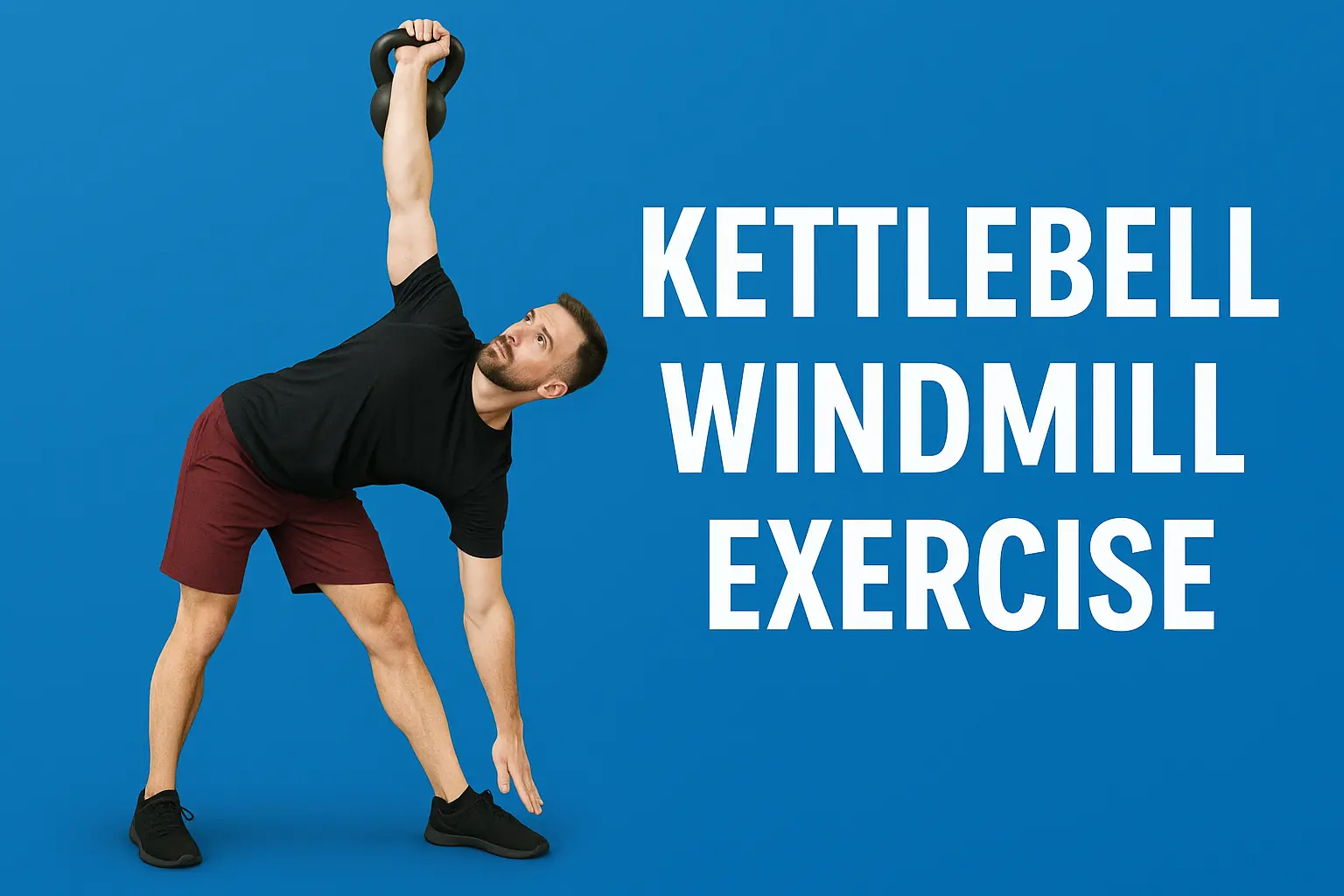
Kettlebell Windmill
The kettlebell windmill is a compound exercise that integrates strength, stability, and flexibility into one controlled movement. It is done by holding a kettlebell overhead with one arm and bending at the hips and twisting the torso, reaching down to the ground with the other hand.
Purpose of the Kettlebell Windmill
The windmill engages:
- Core stability, particularly the obliques and transverse abdominis
- Shoulder mobility and stability (particularly with the kettlebell overhead)
- Hip mobility and hamstring flexibility
- Thoracic spine mobility
How to Perform a Kettlebell Windmill (Step-by-Step)
Start Position:
- Stand with feet slightly more than shoulder-width apart.
- Front foot pointed forward and back foot angled out (~45°).
- Hold a kettlebell in right hand, racked overhead, with arm locked out.
- Let your left arm dangle naturally or place it along the inside of your left leg.
Engage Your Core:
- Brace your core and maintain a neutral spine.
- Maintain your eyes on the kettlebell during the movement for safety and balance.
Hinge & Lower:
- Push your hips back and slide your left hand down the inside of your left leg.
- Maintain your right arm vertical, shoulder packed, and kettlebell stable overhead.
- Go as far down as your flexibility permits—preferably so that you can touch your left hand to the floor or ankle.
Return to Start:
- Reverse the motion by pushing through your hips.
- Keep your core activated as you return to standing.
Muscles Engaged
- Core (obliques, transverse abdominis)
- Shoulders (deltoids, rotator cuff)
- Glutes and hamstrings
- Lats and upper back
Form Tips
- Begin light—master the movement before adding kettlebell weight.
- Keep arm holding kettlebell vertical and shoulder active.
- Move slow and controlled—this is a stability/mobility drill, not a speed movement.
- Warm up your shoulders and hips before performing these.
Variations
- Bodyweight Windmill – for beginners to learn the pattern.
- Bottoms-Up Kettlebell Windmill – advanced variation for shoulder stability.
- Double Kettlebell Windmill – one overhead, the other in the opposite hand or on the ground.
New version:
A Remarkable Reminder for Searching for the Stretch in the Kettlebell Windmill
As you begin executing the kettlebell windmill, the control required during the movement is where the real beauty lies, and where the magic happens. The exercise actually functions as an examination of sorts—it’s more of a clever masquerade in strength training that gauges your mobility and stability.
Set Up Programming for The Kettlebell Windmill
Kettlebell windmill should be considered a multi-functional gadget. One can customize it for caring, stability, core endurance or even mobility based on the windmill routine you choose to incorporate into your training. Here are suggestions for each area.
Kettlebell Windmill Advantages: Key Decompositions
Core Strength & Stability
Improves your obliques, transverse abdominis, and deep core stabilizers.
It prepares you against rotational injury, making movement easier in daily activities, while exercising helps to elevate the ease of motion resistance.
Shoulder Mobility & Stability
While exercising, the shoulder is secured and under smooth control—overhead stability is built.
Crucial for the rotator cuff, the exercise is great for athletes or lifters who frequently tackle overhead.
Hip & Hamstring Flexibility
Also, slowly feels like it strengthens and stretches your hip flexors, hamstrings and glutes.It encourages hip hinging with rotation, which is something not commonly seen in other exercises.
Thoracic Spine Mobility
This helps you rotate and extend the upper back region of your body which is vital for ideal posture.
This is particularly beneficial for people who sit at desks all day or anyone with upper back stiffness.
Unilateral Strength & Coordination
It targets one side of your body, increasing your level of balance, muscular balance, and neuromuscular control.
This helps to address any asymmetry or disparity one might have.
Total Body Control
It requires attention, bodily self consciousness, and exact moving criteria.
You don’t have the ability to just thrust through it; you have to control each part on an individual level.
Functional Movement Carryover
Any form of physical exertion like sports, lifting in a daily routine, yoga, and martial arts can be performed with skill sets developed here.
It minimizes injury risks by enhancing your ability to stabilize under numerous complex planes of motion.