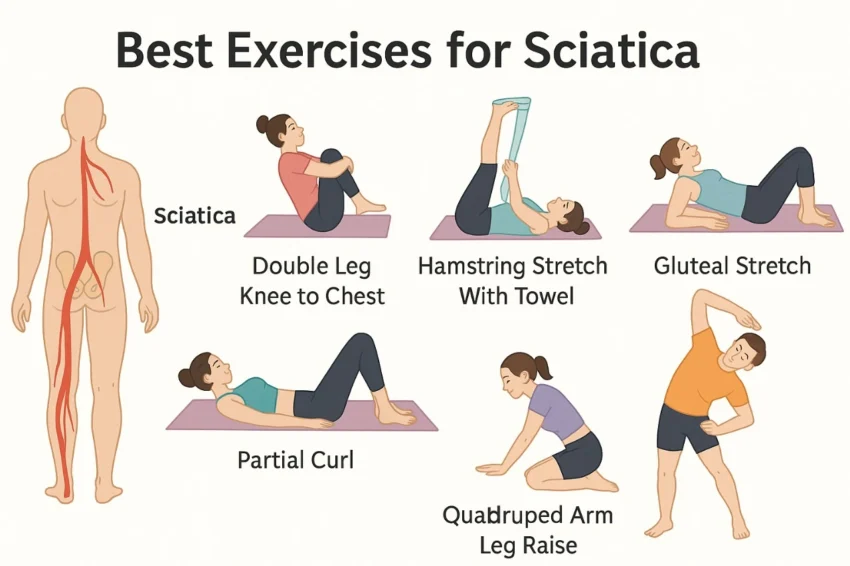
Best Exercises for Sciatica: Complete Guide to Relieve Sciatic Nerve Pain
Sciatica is a sharp, burning, or shooting pain that travels from your lower back through your buttock and down the leg. This happens when the sciatic nerve gets compressed or irritated. The right combination of stretching, strengthening, and nerve-mobility exercises can reduce this pressure and improve movement.
This guide gives you every essential exercise, explains why they work, and tells you what to avoid — so you recover faster and safely.
What Is the Sciatic Nerve?
The sciatic nerve is the largest and longest nerve in your body. It begins in the lower spine, runs through the buttocks, and travels down both legs. When muscles or spinal structures compress this nerve, it causes:
-
Shooting pain
-
Tingling
-
Numbness
-
Muscle weakness
-
Reduced mobility
Understanding the cause helps you choose the right exercises — otherwise, you risk making symptoms worse.
What Causes Sciatica?
Sciatica can be triggered by several conditions, including:
1. Herniated or Bulging Disc
A disc presses directly on the sciatic nerve root.
2. Piriformis Syndrome
The piriformis muscle in the buttock tightens and compresses the nerve.
3. Spinal Stenosis
Narrowing of the spinal canal causing nerve compression.
4. Degenerative Disc Disease
Worn discs irritate the nerve roots.
5. Muscle Imbalance (Weak Core / Tight Hips)
Weak glutes and tight hamstrings pull the pelvis out of alignment and irritate the nerve.
Different causes respond differently, which is why you need stretches + strengthening + nerve glides together.
Types of Sciatica (Why This Matters for Exercise)
1. True Sciatica (Lumbar Nerve Root Compression)
Caused by disc issues. Best treated with:
-
Nerve glides
-
Back-extension-based exercises
-
Core strengthening
2. Piriformis-Related Sciatica
Caused by tight glutes/piriformis. Best treated with:
-
Hip/glute stretches
-
Piriformis stretch
-
Figure-4 stretch
3. Postural or Muscle-Related Sciatica
Caused by weak core + tight hamstrings. Best treated with:
-
Core strengthening
-
Hamstring stretching
-
Hip mobility work
Best Stretches for Sciatica Pain Relief
Below are high-value, physiotherapist-approved movements.
1. Seated Glute Stretch
Targets: Glutes, piriformis
Why it helps: Loosens the muscles that commonly irritate the nerve.
How to do it:
-
Sit with knees bent.
-
Cross ankle over the opposite knee.
-
Lean forward while keeping back straight.
-
Hold 20–30 seconds per side.
2. Figure 4 Stretch
Targets: Hip rotators
Why it helps: Opens the piriformis and hip joint.
How to do it:
-
Lie on your back.
-
Cross ankle over knee.
-
Pull the bottom leg toward your chest.
-
Hold 20–30 seconds.
3. Sitting Spinal Twist
Targets: Lower back, lumbar spine
Why it helps: Reduces tension around nerve roots.
How to do it:
-
Sit with legs straight.
-
Cross one leg over the other.
-
Twist toward the bent knee.
-
Hold 20–30 seconds.
4. Knee to Opposite Shoulder
Targets: Deep glute muscles
How it helps: Releases pressure on the sciatic pathway.
How to do it:
-
Lie on back.
-
Pull knee across body.
-
Hold 20–30 seconds.
5. Standing Hamstring Stretch
Targets: Hamstrings
How it helps: Eases tension on the lower back.
How to do it:
-
Stand tall.
-
Bend from hips toward toes.
-
Hold 20–30 seconds.
6. Standing Piriformis Stretch
Same benefit as the seated version but more intense.
Nerve Mobilization (Nerve Glides) for Sciatica
This is a major gap most low-quality articles miss — but top physiotherapists recommend it.
These do not stretch the nerve. They mobilize it, reducing irritation.
7. Sciatic Nerve Glide (Seated Nerve Floss)
How to do it:
-
Sit upright.
-
Extend one leg forward while keeping toes up.
-
At the same time, lower your chin to your chest.
-
Bend the knee + lift your head.
-
Repeat 10–15 times slowly.
8. Hamstring Nerve Glide (Lying)
How to do it:
-
Lie on back.
-
Lift one leg straight.
-
Flex ankle (toes toward head).
-
Lower and repeat.
-
Do 10–15 reps per leg.
These reduce nerve sensitivity and improve mobility more effectively than stretching alone.
Strengthening Exercises for Long-Term Sciatica Relief
Stretches help immediately.
Strengthening prevents the pain from coming back.
9. Glute Bridge
Strengthens glutes + spine stabilizers.
How to do it:
-
Lie with knees bent.
-
Lift hips up.
-
Hold 2 seconds.
-
Repeat 12–15 reps.
10. Bird-Dog
Strengthens core + improves spinal control.
How to do it:
-
Kneel on hands/knees.
-
Extend opposite arm + leg.
-
Hold 2–3 seconds.
-
Repeat 10 reps each side.
11. Pelvic Tilt
Improves lumbar mobility and stabilizes lower back.
12. Cobra Pose (Back Extension)
Very effective for disc-related sciatica.
Exercises to Avoid with Sciatica
These movements commonly worsen symptoms:
-
Running or jumping
-
Heavy weightlifting
-
Twisting spine movements
-
Straight-leg sit-ups
-
Leg raises
-
Deep forward bending
-
Cycling with poor posture
-
High-impact aerobics
Avoid anything that increases nerve tension.
How Often Should You Do Sciatica Exercises?
-
Acute pain: 1–2 times daily, very gentle
-
Improving phase: 3–4 days per week
-
Maintenance: 2–3 days per week (stretching + strengthening)
When to See a Doctor (Important)
Seek medical help immediately if you experience:
-
Loss of bowel or bladder control
-
Rapid weakness in the leg
-
Numbness in inner thighs (saddle anesthesia)
-
Pain that gets worse despite exercise
-
Inability to stand or walk
-
Sciatica lasting longer than 6 weeks
These signs indicate serious nerve compression.
Tips for Faster Sciatica Relief
-
Use a warm compress before stretching
-
Good sitting posture (avoid slouching)
-
Sleep with pillow between knees
-
Avoid long sitting sessions
-
Use lumbar support
-
Stay active — never rest too long
FAQs About Sciatica Exercises
1. How long until sciatica improves?
Most people improve within 2–6 weeks with consistent exercise.
2. Can sciatica heal without surgery?
Yes — 90% of cases improve with conservative care.
3. Should I stretch during severe pain?
Do gentle nerve glides only until pain calms down.
4. Are these exercises safe for disc herniation?
Yes — but avoid forward bending and add cobra extensions.
5. Is walking good for sciatica?
Yes — walking improves blood flow and reduces stiffness.
Conclusion
Sciatica improves fastest when you combine stretching, nerve mobility, and strengthening. This article covers every critical movement you need. Start slowly, be consistent, and avoid high-impact or twisting exercises that irritate the nerve.
If symptoms worsen or linger longer than 6 weeks, get a medical evaluation.
Related topics
Pullup vs Chinup : What’s the Difference?
David Goggins Weekly Workout Plan