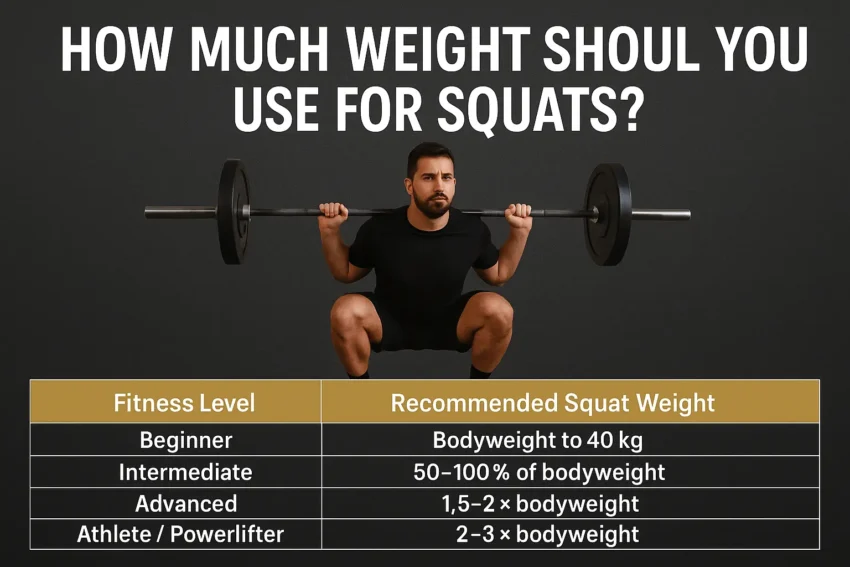
Choosing the right squat weight is one of the most important decisions in strength training. Too little weight gives slow results, and too much weight increases the risk of injury. The correct squat weight depends on your experience level, bodyweight, age, and fitness goal.
This guide gives you exact scientific and practical squat weight recommendations, trusted by coaches and used by real gym athletes.
Ideal Squat Weight by Level
| Level | Ideal Squat Weight |
|---|---|
| Beginner | Bodyweight to 40 kg |
| Intermediate | 50–100% of bodyweight |
| Advanced | 1.5–2× bodyweight |
| Athlete / Powerlifter | 2–3× bodyweight |
✅ These numbers are for proper depth squats with correct form.
Why Choosing the Right Squat Weight Matters
Using the correct squat weight helps you:
- Build lean muscle faster
- Increase leg and core strength
- Protect knees and lower back
- Improve posture and balance
- Burn maximum calories
Using the wrong weight leads to:
- Knee pain and joint stress
- Back injuries
- Poor squat depth
- Weak muscle development
- Long-term training setbacks
How Much Weight Should a Beginner Squat?
If you are new to the gym, your first goal is learning perfect squat form, not lifting heavy.
✅ Beginner Starting Progression:
- Start with bodyweight squats
- Move to empty barbell (20 kg)
- Increase to 30–40 kg within 3–5 weeks
✅ Average Beginner Targets:
- Men: 30–50 kg
- Women: 20–40 kg
👉 A beginner should never rush heavy weight. Strong foundations prevent future injuries.
Intermediate Squat Weight Guide
You are intermediate if:
- You have trained for 3–12 months
- Your squat depth and balance are consistent
✅ Recommended Load:
- 70–100% of bodyweight
Example:
If you weigh 70 kg, your working squat range should be 50–70 kg.
Advanced Squat Weight Standards
You are advanced if:
- You have trained for 1–3+ years
- You squat with full depth and strong core control
✅ Target Range:
- 1.5–2× your bodyweight
Example:
An 80 kg lifter squatting 120–160 kg is considered very strong.
How Much Weight Should Women Use for Squats?
Women naturally have strong lower bodies and respond very well to squat training.
| Level | Recommended Weight |
|---|---|
| Beginner | 20–40 kg |
| Intermediate | 40–70 kg |
| Advanced | 80–120+ kg |
✅ Heavy squats will not make women bulky. They shape the body, burn fat, and improve strength.
Squat Weight Based on Fitness Goals
| Goal | Weight Style | Reps |
|---|---|---|
| Fat Loss | Light–Moderate | 12–15 |
| Muscle Growth | Moderate–Heavy | 8–12 |
| Strength | Heavy | 3–6 |
| Endurance | Light | 15–20 |
Your squat weight should always match your training goal.
How to Know If Your Squat Weight Is Too Heavy
Your squat weight is too heavy if:
- You cannot reach proper depth
- Your lower back rounds
- Knees collapse inward
- You lose balance
- You feel joint pain instead of muscle burn
✅ If any of these happen → reduce the weight immediately.
Perfect Squat Weight Selection Rule (Coach Formula)
Choose a weight that allows 8–12 clean reps, while still leaving 1–2 reps in reserve.
This is the safest way to gain muscle and strength without injury.
How Fast Should You Increase Squat Weight?
Safe progression speed:
- Increase 2.5–5 kg per week
- Only increase if:
- Last workout felt controlled
- No knee or back pain
- Full squat depth was achieved
Scientific Strength Standards for Squats
- Squatting your bodyweight → Good
- Squatting 1.5× bodyweight → Strong
- Squatting 2× bodyweight → Elite level
These are globally accepted gym strength benchmarks.
Can You Squat Every Day?
No. Squats stress:
- Nervous system
- Knees
- Lower back
✅ Best frequency:
- Beginners: 2–3 times per week
- Advanced: 3–4 times per week
Biggest Mistakes People Make With Squat Weight
- Ego lifting
- Copying advanced lifters
- Skipping warm-ups
- Chasing big numbers too early
- Ignoring pain signals
✅ Real progress comes from smart training, not heavy shortcuts.
FAQS
How much weight should I squat as a beginner?
Most beginners should start with bodyweight, then move to 20–40 kg within the first month.
Is squatting your own bodyweight good?
Yes, it is a solid intermediate strength level.
Is 100 kg squat strong?
Yes, 100 kg is considered strong for general gym lifters.
Should I squat heavy for fat loss?
Moderate weight with higher reps works best for fat loss.
Can light squats build muscle?
Yes, when done with high volume and slow tempo.
Final Verdict
There is no single perfect squat weight for everyone. The best squat weight is the one that:
- Matches your experience
- Matches your bodyweight
- Matches your goal
- Maintains perfect technique
- Builds strength safely over time
✅ If your form is perfect, your progress will always come—slow but permanent.
Related topics:
Benefits of Squats, Variations, and Muscles Worked