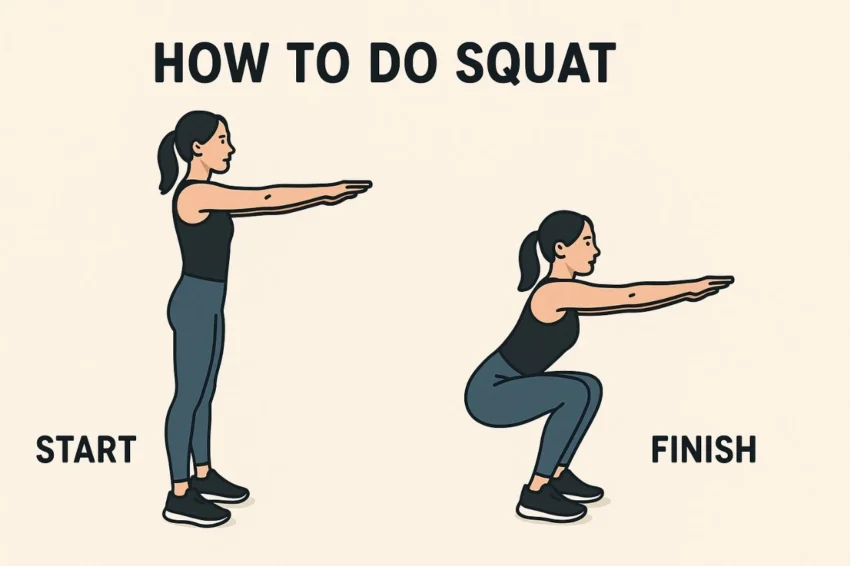
To do a squat properly, stand with your feet shoulder-width apart, brace your core, push your hips back, bend your knees while keeping your chest lifted and spine neutral, lower until your thighs are parallel to the floor, keep your heels down, and drive through your heels to stand back up. Keep your knees aligned with your toes.
What is Squat ?
The squat is one of the most effective exercises for strengthening the legs, glutes, and core. It improves mobility, posture, athletic performance, balance, and everyday movement patterns like lifting and climbing stairs. However, correct technique is essential — poor form can cause knee strain, back pain, or long-term joint issues.
This guide gives you everything you need to perform a squat safely and effectively, based on the best insights from fitness experts, physiotherapists, and strength coaches.
Warm-Up & Mobility Before Squats
A proper warm-up improves depth, reduces pain, and protects knees/lower back.
Recommended 3–5 minute warm-up:
- Hip circles – 10 each direction
- Leg swings (forward/back) – 15 each leg
- Ankle mobility rocks – 10 each leg
- Bodyweight lunges – 6 each side
- Cat-cow spine mobility – 10 reps
This opens the hips, improves ankle flexibility, and prepares your core.
How to Do a Squat Properly (Step-by-Step)
1. Set Your Foot Position
- Stand tall with feet shoulder-width apart
- Toes slightly turned outward (15–30°)
- Weight evenly distributed across whole foot
This stance supports balance and natural hip movement.
2. Brace Your Core
- Tighten your abs like someone is poking them
- Lift your chest gently
- Keep the spine neutral
This prevents lower-back rounding.
3. Push Your Hips Back First
- Start the squat by pushing your hips backward
- Imagine sitting on a chair behind you
This reduces knee stress and improves alignment.
4. Lower Your Body Slowly
- Bend your knees while keeping your chest up
- Knees must follow toe direction (never collapsing inward)
- Keep heels firmly on the ground
- Maintain neutral spine — do not round your lower back
Control is more important than speed.
5. Reach the Correct Depth
Choose based on your mobility:
- Parallel Squat: thighs parallel to floor
- Deep Squat: hips below knees (only if back stays neutral)
Stop if your lower back starts rounding (“butt wink”).
6. Stand Up With Power
- Push the ground away using your heels
- Straighten knees and hips together
- Squeeze glutes at the top
- Keep chest up and core tight
Repeat for your desired reps.
Squats for Beginners (Progression Path)
If you’re new to squats or struggle with form, follow this progression:
Stage 1: Chair Squat (Assisted)
Sit back onto a chair → stand up.
Builds confidence and correct hip movement.
Stage 2: Wall Squat
Keeps your chest upright and trains proper alignment.
Stage 3: Bodyweight (Air) Squat
The full squat without assistance.
Stage 4: Goblet Squat
Hold a dumbbell/kettlebell to improve posture and core strength.
Stage 5: Weighted Squats
Barbell back squat or front squat for strength and muscle building.
Common Squat Mistakes and How to Fix Them
❌ 1. Heels Lifting Off the Ground
Fix: Improve ankle mobility, widen stance slightly, push hips back.
❌ 2. Knees Caving In
Fix: Actively push knees outward; strengthen glutes and hips.
❌ 3. Leaning Too Far Forward
Fix: Bring feet slightly closer, engage your core, lift chest.
❌ 4. Lower-Back Rounding (“Butt Wink”)
Fix: Reduce depth, improve hip/hamstring mobility, brace harder.
Do Squats Burn Calories and Help With Weight Loss?
Yes. Squats activate large muscle groups, which increases calorie burn.
Average calorie burn estimate:
- 30 minutes of squats: approx. 180–230 calories (based on body weight)
Because squats boost muscle mass, they also increase daily metabolic rate, helping with weight loss even outside the gym.
How Often Should You Do Squats?
For Beginners:
2–3 times per week
10–15 reps × 2–3 sets
For Fat Loss:
3–4 sessions per week
15–20 reps × 3–4 sets
For Muscle/Strength:
2–3 heavy sessions per week
5–8 reps × 4–5 sets
Who Should Avoid or Modify Squats?
Modify or avoid squats if you have:
- Severe knee osteoarthritis
- Lower-back herniation or disc issues
- Recent hip/knee surgery
- Uncontrolled knee pain
- Balance disorders
Safe alternatives:
- Partial squats
- Wall squats
- TRX-assisted squats
- Leg press (gym)
Always consult a physiotherapist if pain persists.
Are Squats Bad for Your Knees or Back?
Squats are not harmful when performed with proper form.
They actually strengthen the muscles that protect your knees and spine.
Squats may hurt if:
- You lean too far forward
- Heels lift off the ground
- Your knees collapse inward
- You lift too heavy too soon
- You lack hip/ankle mobility
Correct form eliminates most of these problems.
How to Add Weight to Squats
Dumbbells: goblet squat
Kettlebell: front-loaded squat
Barbell:
- Back squat
- Front squat
- Zercher squat
Start with light weight and progress gradually.
Muscles Worked During Squats
- Quadriceps
- Hamstrings
- Glutes
- Calves
- Hip flexors
- Adductors
- Core (abs + lower back stabilizers)
This makes squats a full lower-body workout.
Faqs
1. How should beginners start squats?
Begin with chair squats, then progress to bodyweight squats once comfortable.
2. Do squats make your butt bigger?
Yes. Deep squats activate the glutes deeply and help build butt muscle.
3. Do squats reduce belly fat?
Indirectly. Squats burn calories and build muscle, helping reduce overall body fat.
4. What if I can’t squat deep?
Improve ankle/hip mobility and reduce depth temporarily.
5. Can I do squats with knee pain?
Yes, but only if the pain is mild and form is correct. Start with partial squats and avoid heavy weights.
6. Should my knees pass my toes?
A small amount is natural, as long as heels stay down and spine stays neutral.
7. Can I squat every day?
Daily light bodyweight squats are fine; weighted squats need rest days.
Conclusion
Squats are one of the most powerful exercises for building a strong lower body, improving mobility, and enhancing overall fitness. With correct form, a solid warm-up, and gradual progression, squats are safe and effective for almost everyone. Use this guide to master your technique and unlock the full benefits of one of the most essential movements in fitness.
Related topics: