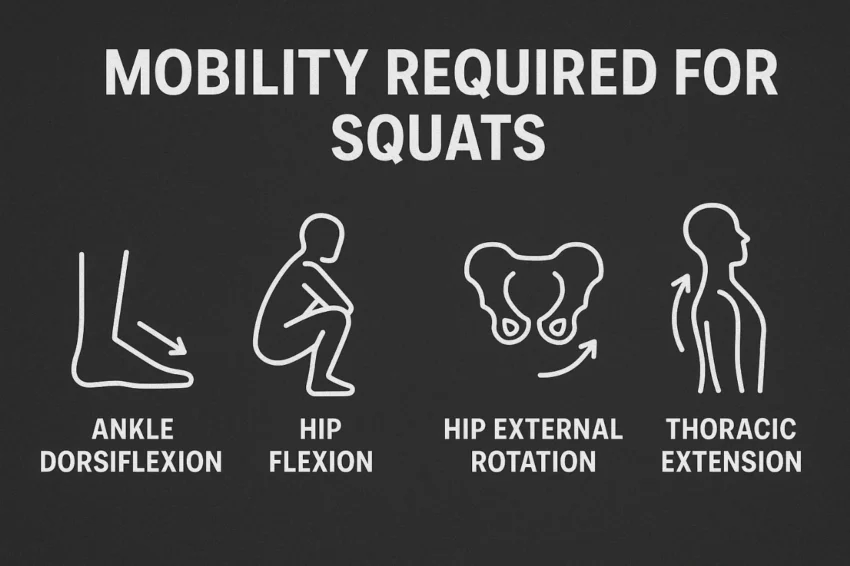
Why Mobility Matters in Squats
A great squat doesn’t start with strength — it starts with mobility.
Your ankles, hips, and upper back must move freely for you to squat deep without pain or losing balance.
When mobility is limited, you experience:
- Heels lifting off the floor
- Knees caving inward
- Lower back rounding (butt wink)
- Shallow depth
- Hip or knee discomfort
- Forward torso lean
Fixing mobility is the easiest way to instantly improve your squat form.
1. Ankle Mobility: Your Foundation for Depth
Ankles control how far your knees travel forward.
If they’re tight, you cannot squat deep — no matter how strong you are.
Signs of Tight Ankles
- Heels rise in the bottom position
- Torso falls forward
- Squat feels unstable
Best Exercises to Improve Ankle Mobility
1. Knee-to-Wall Stretch
Move the knee forward while keeping the heel down.
Hold: 30–45 seconds each side.
2. Weighted Ankle Rocks
Gently push the knee forward with a light plate.
Reps: 12–15.
3. Soleus Stretch (Bent-Knee Calf Stretch)
Targets deep ankle flexibility.
Hold: 30 seconds.
4. Tibialis Raises
Strengthens the shin muscles for stability.
Reps: 15–20.
Improving ankle mobility alone helps many people instantly gain more squat depth.
2. Hip Mobility: Unlock a Deeper, Safer Squat
Hips drive the movement.
When they’re tight, the squat becomes restricted and uncomfortable.
Signs of Tight Hips
- Knees collapse inward
- Difficulty reaching depth
- Lower back rounding
Best Exercises to Improve Hip Mobility
1. 90/90 Hip Stretch
Great for internal + external rotation.
Hold: 45–60 seconds.
2. Hip Flexor Lunge Stretch
Releases tight hip flexors from long sitting.
Hold: 30 seconds each side.
3. Glute/Piriformis Stretch
Reduces tension in outer hips.
Hold: 30–45 seconds.
4. Pigeon Stretch
Opens the glutes deeply for a smooth bottom position.
3. Thoracic (Upper Back) Mobility: Fix Your Squat Posture
A stiff upper back forces your torso to lean forward during squats.
Best Exercises
1. Foam Roll (Upper Back)
Roll for 20–30 seconds.
2. Bench Thoracic Extensions
Place elbows on bench and sit back.
Opens the chest and upper spine.
3. Cat–Cow Drill
Boosts overall spinal mobility.
4. Simple 5-Minute Daily Mobility Routine
Do this before squats or anytime during the day for fast results:
- Knee-to-Wall Stretch — 30 sec each
- Hip Flexor Stretch — 30 sec each
- 90/90 Hip Stretch — 45 sec
- Foam Roll Upper Back — 20 sec
- Deep Squat Hold (Assisted) — 20–30 sec
Consistent use of this routine improves depth, balance, and comfort in 1–2 weeks.
5. Fixing Common Squat Mobility Problems
Heels Lifting
Cause: Tight ankles
Fix: Soleus stretch + ankle rocks
Knees Caving In
Cause: Hip rotation weakness or tightness
Fix: 90/90 stretch + glute activation
Butt Wink
Cause: Hip limitations or poor bracing
Fix: Hip flexor stretch + practice deep squat holds
Forward Lean
Cause: Tight upper back
Fix: Thoracic extensions
6. How Long Does It Take to See Results?
With consistent mobility training:
- 1 week: More comfort
- 2–3 weeks: Improved depth + stability
- 4 weeks: Noticeable improvement in technique
Mobility improves fast when practiced regularly.
FAQs
1. Why is mobility important for squats?
Mobility allows your ankles, hips, and spine to move freely so you can squat deeper with better balance, proper form, and less pain.
2. How do I know if my ankles are limiting my squat?
If your heels lift, your knees don’t move forward, or your torso leans too much, your ankles lack dorsiflexion.
3. How long does it take to improve squat mobility?
Most people see improvement within 1–3 weeks with consistent mobility work.
4. Should I stretch before or after squats?
Mobility drills and dynamic stretches are best before squats.
Long static stretches should be done after your workout.
5. Can tight hips affect my squat depth?
Yes. Tight hip flexors or restricted hip rotation prevents you from reaching full depth and may cause knee collapse.
6. Can ankle mobility alone fix my squat?
Often yes — limited ankle dorsiflexion is one of the biggest reasons people struggle with depth and balance.
7. How often should I train squat mobility?
Daily is ideal, but 4–5 times per week is enough for most people.
8. Does poor mobility cause knee pain when squatting?
Yes. Tight ankles or hips can force your knees into poor positions, increasing stress and discomfort.
9. What is the best mobility exercise for squats?
There is no single “best,” but the most effective combo is:
Knee-to-wall stretch + 90/90 hip rotation + deep squat hold.
10. Can improving mobility help me lift heavier weights?
Absolutely. Better mobility improves squat depth, balance, and stability — allowing you to lift heavier with safer form.
11. What is a quick mobility routine I can do every day?
A simple 5-minute routine:
- Knee-to-wall stretch
- Hip flexor stretch
- 90/90 hip stretch
- Deep squat hold
12. Do I need equipment for squat mobility?
No. Most mobility exercises use only your bodyweight. A foam roller or small weight plate is optional.
⭐ Final Thoughts
Good squat mobility isn’t about being flexible — it’s about allowing your body to move naturally.
By improving your ankles, hips, and upper back, you unlock deeper, stronger, and injury-free squats.
Related topics:
Types of Squats and When to Use Each
Benefits of Squats, Variations, and Muscles Worked