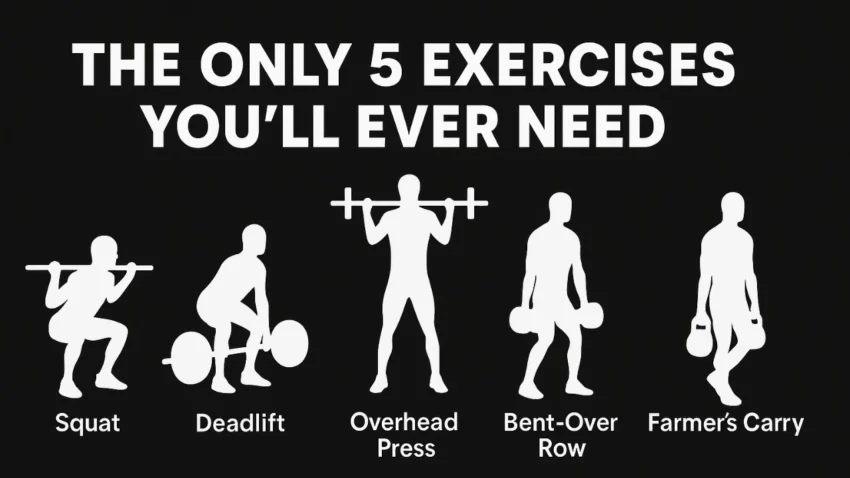
Most people waste time chasing 20–40 different exercises, confusing complexity with effectiveness. The truth is brutally simple: your body doesn’t care about “biceps day” or a dozen machine variations — it adapts to movement patterns, not individual muscles.
Five patterns cover everything:
-
Lower-body strength
-
Posterior chain power
-
Upper-body push
-
Upper-body pull
-
Core stability & posture
This approach gives you:
-
Faster progress
-
Less confusion
-
Better technique
-
Minimal equipment
-
Sustainable long-term training
If you want real results without BS, these five patterns are the backbone.
What Makes an Exercise “Essential”?
To qualify as one of the “only five you’ll ever need,” an exercise must be:
✔ Compound (multi-joint)
You hit more muscles in less time.
✔ Functional
It carries over to daily life and sports.
✔ Scalable
A beginner at home and a pro athlete can both use it.
✔ Safe when done correctly
Modifiable based on mobility or injury history.
✔ Efficient
One good movement replaces 4–5 isolation exercises.
The Only 5 Exercises You’ll Ever Need
Below are the five essential movement patterns — each with why it matters, best variations, and technique cues.
Exercise 1: Squat (The Foundation of Lower-Body Strength)
Why it matters
Squats train quads, glutes, hamstrings, and core. They improve balance, mobility, jumping power, and knee/hip stability. If you can’t squat well, your daily movement suffers.
Best variations
-
Bodyweight squat
-
Goblet squat
-
Front squat
-
Back squat
-
Bulgarian split squat (for imbalances)
Key technique cue
Sit back and down, keep chest tall, knees track over toes.
Exercise 2: Hip-Hinge / Deadlift (Posterior Chain Powerhouse)
Why it matters
Deadlifts and RDLs hammer the hamstrings, glutes, and lower back. This movement pattern protects your spine, improves posture, and builds real-world strength (lifting heavy objects safely).
Best variations
-
Romanian deadlift
-
Trap-bar deadlift
-
Sumo deadlift
-
Kettlebell swing (for speed and power)
Key cue
Push hips back like closing a car door with your butt — not bending your spine.
Exercise 3: Push (Upper-Body Pressing Strength)
Why it matters
Push movements build chest, shoulders, triceps, and core stability. They balance your upper body strength with pull movements.
Best variations
-
Incline push-up
-
Standard push-up
-
Weighted push-up
-
Bench press
-
Overhead press
Key cue
Brace your core — don’t let your lower back sag.
Exercise 4: Pull (Upper-Body Back & Posture Strength)
Why it matters
Pulling keeps your shoulders healthy, fixes posture, and develops your back, biceps, and grip strength. It also balances push movements.
Best variations
-
Inverted row
-
Bent-over row
-
Cable row
-
Single-arm dumbbell row
Key cue
Pull your elbows toward your ribcage and avoid shrugging.
Exercise 5: Loaded Carry / Plank (Core Stability & Total-Body Control)
Why it matters
Your core’s real job is stability, not endless crunches. Loaded carries and planks build anti-rotation strength, posture, grip, and overall body control.
Best variations
-
Farmer’s carry
-
Suitcase carry (one side)
-
Front rack carry
-
Plank
-
Side plank
Key cue
Stand tall, ribs down, glutes tight.
How to Build a Simple, Effective Weekly Routine
3-Day Full-Body Routine (Beginner → Intermediate)
Use this Mon/Wed/Fri or Tue/Thu/Sat.
Day A/B/C (repeat this template):
-
Squat — 3×6–10
-
Hinge — 3×4–8
-
Push — 3×6–12
-
Pull — 3×6–12
-
Carry/Plank — 3×30–60 sec
Increase load or reps whenever you hit the top of the rep range with clean form.
Progression Rules That Guarantee Results
-
Lift heavier when reps feel easier
-
Add 1–2 reps each week
-
Slow down the tempo to improve control
-
Reduce rest times gradually
-
Switch to harder variations every 4–8 weeks
Progression > exercise variety.
Common Mistakes to Avoid
-
Using light weights forever
-
Rushing form
-
Ignoring imbalances (split squats fix this fast)
-
Training only push movements
-
Avoiding carries (they’re the easiest way to get strong fast)
Fix these and your training results skyrocket.
When These Five Exercises Aren’t Enough
You only need more variation if:
-
You’re bodybuilding and want to isolate specific muscles
-
You’re training for a sport (sprinter, fighter, powerlifter, Olympic lifter)
-
You’re rehabbing an injury and need specialized movements
For 90% of people, these five exercises cover nearly everything.
Quick Sample Workouts
Home (No Equipment)
-
Squat — 3×12
-
Hip-hinge drill — 3×15
-
Push-up — 3×10
-
Table rows — 3×12
-
Plank — 3×45 sec
Gym (Minimal Equipment)
-
Goblet squat — 3×10
-
Romanian deadlift — 3×8
-
Bench press — 3×8
-
Lat pulldown — 3×10
-
Farmer’s carry — 3×45 sec
FAQ
Q: Can these five exercises build muscle?
Yes — they build more muscle per minute than most isolation exercises.
Q: Can beginners use this routine?
Absolutely. Start with lighter variations and progress weekly.
Q: How long until I see results?
Strength improves in 3–6 weeks; visible changes in 8–12 weeks.
Q: Do I need equipment?
No. You can start with bodyweight variations at home.
Final Verdict
Forget the nonsense routines with 30 exercises. You only need five movement patterns to build strength, mobility, stamina, and long-term fitness. Master the basics, increase the load gradually, and stay consistent. The results will take care of themselves.