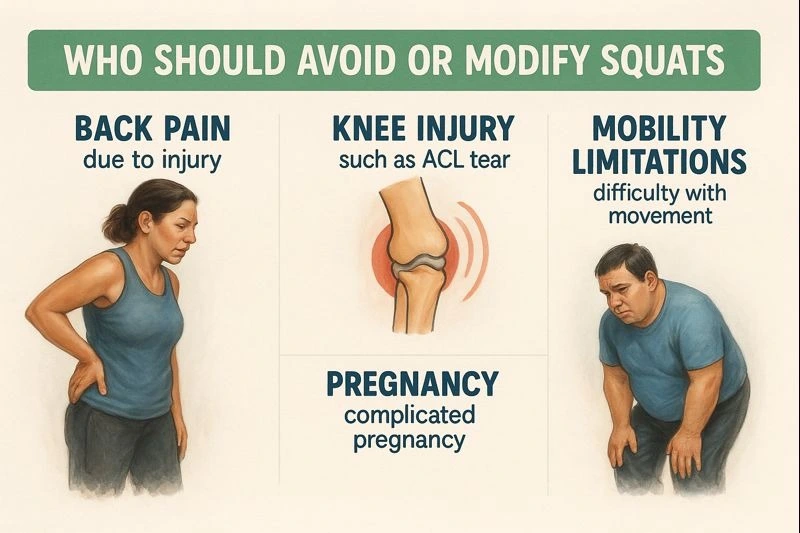
Squats are an excellent exercise for building strength, balance, and lower-body muscle. But they are not suitable for everyone in the same way. Some people should avoid heavy or deep squats, while many others only need small modifications to squat safely and pain-free.
This guide explains who should avoid squats, who should modify them, and how to make squats safer for every fitness level.
Who Should Avoid Squats Completely?
You should avoid traditional squats if you have:
• Serious Knee Injuries
ACL/MCL tears, meniscus injuries, or severe tendon inflammation can worsen with deep bending or heavy loading.
• Lower-Back Conditions
Disc herniation, sciatica, and chronic lower-back pain may be aggravated by spinal compression during squats.
• Hip Problems
Hip impingement, arthritis, or a labral tear can cause sharp pain or limited movement during squatting.
• Recent Surgery
Avoid squats if you recently had surgery on your knee, hip, spine, or abdomen. Always wait for medical clearance.
• Sharp or Uncontrolled Pain
If squats cause sharp pain, locking, swelling, or numbness, stop immediately.
In these cases, traditional squats may do more harm than good.
Who CAN Squat With Modifications?
Many people do not need to avoid squats entirely — they just need variations that reduce stress and improve form.
• Mild Knee Pain
Try:
- Box squats
- Wall squats
- Partial-range squats
• Tight Hips or Ankles
Try:
- Heel-elevated squats
- Wider stance
- TRX-supported squats
• Beginners or Overweight Individuals
Try:
- Chair squats
- Counterbalance squats
- Bodyweight-only squats
• Pregnancy (With Doctor’s Approval)
Try:
- Sumo stance
- TRX squats
- Reduced depth
These variations keep the movement safe and accessible.
Signs You Should Stop Squatting Immediately
Stop squatting if you experience:
- Sharp knee, hip, or back pain
- Pain radiating down the leg
- Knee catching, clicking, or locking
- Tingling or numbness
- Loss of balance
- Swelling after your workout
These are warning signs that something is wrong.
Best Alternatives If Squats Hurt
You can still build strong legs without squatting. Effective alternatives include:
- Leg press
- Hip thrusts
- Step-ups
- Split squats
- Glute bridges
- Hamstring curls
These exercises train similar muscles with less joint stress.
How to Make Squats Safer for Everyone
Warm Up Properly
Use hip mobility, ankle mobility, and glute activation drills.
Choose a Comfortable Depth
Squat only as low as your mobility allows without pain.
Focus on Form
Keep your chest up, knees aligned with toes, and core tight.
Progress Slowly
Increase weight or volume gradually — no more than 5–10% per week.
Strengthen Weak Areas
Weak glutes, tight hips, poor ankle mobility, or a weak core often cause discomfort during squats.
FAQs
1. Who should not do squats at all?
People with severe knee injuries, recent surgeries, serious hip problems, or uncontrolled lower-back conditions should avoid traditional squats until cleared by a medical professional.
2. Are squats bad for your knees?
No, squats are safe for healthy knees when done with proper form. They become risky only if you already have injuries or squat with poor technique.
3. Can I squat if I have lower-back pain?
Avoid heavy back squats if you have back pain. Instead, try goblet squats, bodyweight squats, or consult a physiotherapist.
4. Should seniors avoid squats?
No. Seniors can safely do modified squats like chair squats or TRX-supported squats. These improve strength and balance.
5. Can overweight people do squats?
Yes. Start with chair squats, partial squats, or wall squats, and progress as strength improves.
6. Is it okay to squat with knee pain?
If the pain is sharp or increases with movement, avoid squats. If it’s mild or stiffness-related, try modified squats like box squats.
Conclusion
Squats are a powerful exercise, but they are not a one-size-fits-all movement. Some people should avoid them temporarily, while many can continue safely with simple modif vtcations. Listening to your body, improving technique, and choosing the right variation can help you squat comfortably and safely.
A safe squat is always better than a painful one — and there is always a version of the squat that fits your body.
Related topics:
How Many Squats Should You Do?
Common Squat Mistakes and How to Fix Them
Muscles Worked During Squats (Full Breakdown)